

Why Hustle-Culture Isn’t Enough in an “AI-First” Org
There’s a version of your organization that looks like it’s ready for AI. Fast-moving teams. A bias for action. Leaders who pride themselves on getting things done. From the outside, it looks like exactly the kind of culture that should be first to the table.
It’s not.
The organizations that will actually win with AI aren’t the ones with the most hustle. They’re the ones with the most infrastructure. And right now, a lot of orgs that think they’re early adopters are about to discover they’re late — not because they moved too slowly, but because they can’t build on top of the messy systems they’ve spent years ignoring.
The Hustle Culture Trap
Hustle culture has a compelling surface logic: if your people work hard enough, smart enough, and fast enough, the org will hit its goals. And for a long time, that logic held. In early-stage companies especially, sheer effort can substitute for almost everything — process, documentation, systems, infrastructure.
The problem is that hustle culture is a loan, not an asset. It generates short-term results by borrowing against the long-term health of the organization. Every quarter you close on the back of an all-hands push is a quarter the root problem got cheaper to fix — and you passed.
From the outside, hustle culture looks like high performance. Impressive results. A team that gets it done. What it actually looks like from the inside is something different: burned-out teams, stalled strategic initiatives, and processes that only work because the right people are holding them together.
That gap — between what your org looks like it can do and what it can actually do without the right people propping it up — is survivable in a world where the pace of change is manageable. In the AI era, it’s not.
AI Amplifies What’s Already There
Here’s what the AI conversation gets wrong: it treats implementation as primarily a technology problem. Buy the right tools. Hire the right people. Train the team. Deploy.
But AI doesn’t drop into a vacuum. It drops into your existing systems, processes, and workflows. And what it does — reliably and without sentiment — is amplify whatever is already there.
If your processes are documented, consistent, and built on clean data, AI accelerates them. It finds the patterns faster, executes the repeatable work better, and frees your people to focus on the judgment calls that actually require human intelligence.
If your processes are undocumented, inconsistent, and dependent on institutional knowledge that lives in people’s heads — AI amplifies that too. It automates the chaos. It scales the workarounds. It makes the broken things break faster and at higher volume.
This is why the orgs that seem most eager to adopt AI are often the least ready for it. They’re moving fast because they always move fast. But speed without infrastructure doesn’t produce competitive advantage in the AI era. It produces automated dysfunction.
The Early Adopter Illusion
Right now, there are organizations pouring resources into AI implementation — piloting tools, running experiments, building internal task forces — who will look back in 18 months and wonder why none of it compounded.
The answer will be the same in every case: they tried to build on top of systems that were never designed to scale. The AI layer exposed what hustle had been hiding.
Consider what AI actually requires to function well:
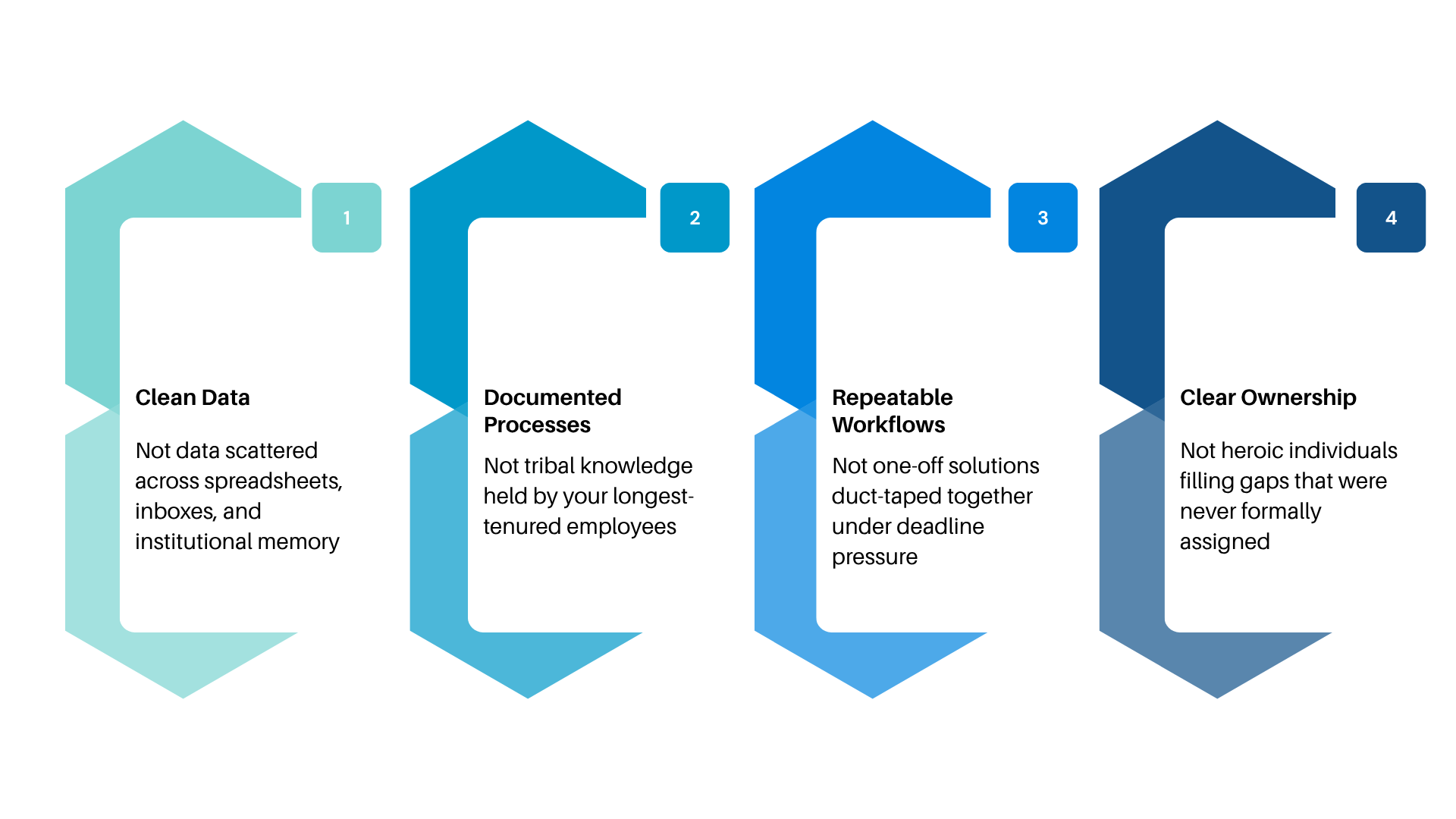
Clean, consistent data — not data scattered across spreadsheets, inboxes, and institutional memory
Example: An insurance agency tries to implement AI-driven renewal outreach. It can't run because policy data lives in the agency management system, premium financing lives in a spreadsheet, and contact preferences live in a producer's personal notes app.
Documented processes — not tribal knowledge held by your longest-tenured employees
Example: Your sales team implements AI pipeline forecasting. The output is meaningless because deal stage definitions mean something different to every rep — and no one ever standardized them.
Repeatable Workflows — not one-off solutions duct-taped together under deadline pressure
Example: A sales org automates their outbound sequence with AI. Conversion tanks because the real sequence — the one that worked — existed only in the top rep's head.
Clear ownership and accountability structures — not heroic individuals filling gaps that were never formally assigned
Example: A company deploys AI to surface expansion opportunities. Six months later, nothing has been acted on — because sales owns new business, customer success owns retention, and expansion falls between them.
The organizations that are genuinely positioned to win with AI didn’t start preparing when AI became mainstream. They started years ago — by building the infrastructure, documenting the processes, and creating the operational foundation that AI needs to deliver on its actual promise.
What AI-Readiness Actually Looks Like
AI readiness isn’t a technology audit. It’s an operations audit. Before your org can effectively leverage AI, it needs to be able to answer these questions honestly:
What AI-Readiness Looks Like
Is your data clean, centralized, and structured — or is it fragmented across systems that were never designed to talk to each other?
Are your core processes documented well enough that an AI tool could execute them consistently — or do they exist only in the heads of your best people?
When you implement a new tool, does adoption stick — or does it depend on one internal champion who eventually burns out or moves on?
Do you have the operational discipline to maintain AI outputs, catch errors, and course-correct — or will AI just add another layer that requires heroic effort to manage?
If those questions are uncomfortable, that’s useful information. It means the work that needs to happen before AI implementation is operational, not technical.
The Shift That’s Required
The organizations that will lead in the AI era share a common characteristic: they stopped relying on hustle as a strategy before it became a liability. They invested in systems, documentation, and infrastructure not because it was glamorous, but because they understood that sustained performance requires a foundation that doesn’t depend on any single person’s effort or memory.
That shift — from stamina to strategy — is harder than it sounds in cultures that have been rewarding heroics for years. It requires leaders to acknowledge that the quarterly saves, the all-hands pushes, and the individual acts of heroism that feel like culture strengths are often symptoms of something that needs to be fixed.
It requires reorienting what gets recognized, what gets resourced, and what gets treated as a strategic priority. The person who documents the process, cleans the data, and builds the system that makes AI actually work deserves as much credit as the person who closed the quarter.
AI will force a reckoning with hustle culture. The infrastructure gap your team has been outrunning with effort becomes visible the moment AI tries to systematize it. Fix it deliberately, on your own time- that window is closing.
The Real Competitive Advantage
The AI era isn’t going to reward the organizations that move fastest. It’s going to reward the organizations that are most ready — the ones whose systems are clean enough, documented enough, and consistent enough that AI can actually do what it promises.
If your org is still running on hustle, the question isn’t whether AI will expose that. It’s when.
The leaders who are building real competitive advantage right now aren’t the ones chasing the latest AI tools. They’re the ones quietly fixing the operational foundation that will determine whether those tools ever deliver at scale.
As always — every tool is only as good as the system it runs on.
If this resonated, follow along — I write regularly about the operational patterns that determine whether scaling organizations thrive or stall.
