

Why Success Still Feels Like Survival — And How to Close the Gap
From the outside, your book size looks like freedom. From the inside, it feels like more weight on the same foundation.
Most agency owners can feel when their business outgrows their systems. What worked at earlier stages — tribal knowledge, hero producers, the owner’s instinct — starts breaking as you scale. Suddenly you’re hiring faster than you can train, top performers are inconsistent, new producers flame out at 60%, and cross-sell is a suggestion rather than a system.
The gap between agency size and operational maturity is where good owners get stuck. Book size doesn’t solve the structure problem. It magnifies it. And most owners never name it clearly enough to fix it.
Here’s what I’ve learned building performance systems for hundreds of agencies: the problem isn’t your people. It’s that you’re still managing by feel instead of by system.
The Four Numbers That Tell the Real Story
When I work with agencies at various stages of growth, I see the same pattern: leadership teams excelling at one or two core pillars while struggling to systematize the rest. Meanwhile, the four numbers that actually predict performance are either ignored or inconsistently measured across locations — new leads, closing ratio, cross-sell ratio and household penetration, and retention. You don’t need a dashboard with 40 metrics. You need mastery of these four.
Why Most Teams Over-Index on One — and Pay for It
Almost every agency I work with is strong in one or two areas and underperforming in the others. You can spot the pattern immediately by looking at their numbers:
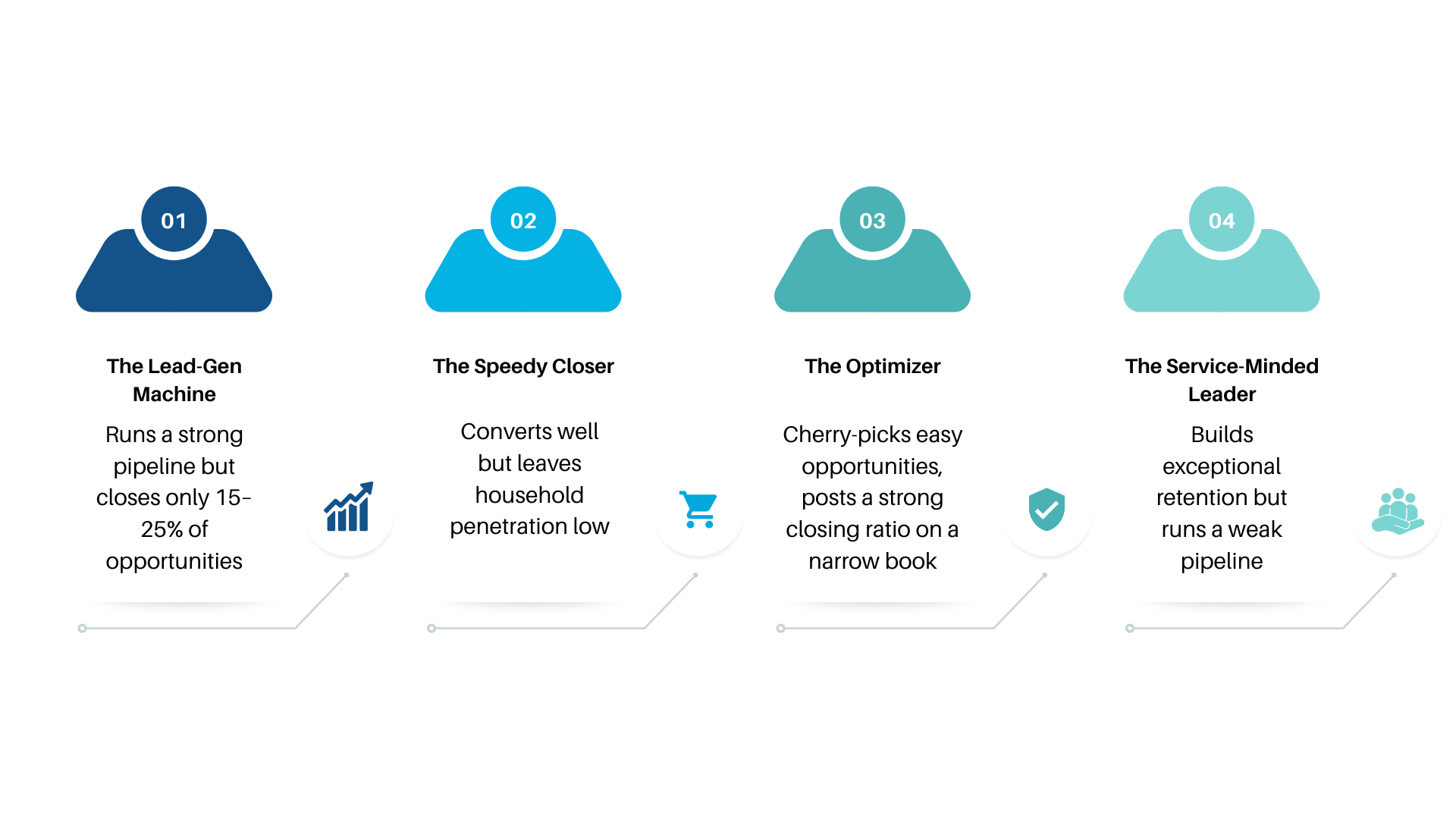
The Lead Gen Machine runs a strong pipeline but closes only 15–25% of opportunities — well below the 35–45% benchmark — with minimal cross-sell and below-average retention.
The Speedy Closer converts well but leaves household penetration at 1.2 policies when it could be 2.2 or higher, and retention softens after year two.
The Optimizer cherry-picks easy opportunities, posts a strong closing ratio on a narrow book, and avoids the complex accounts where real revenue lives.
The Service-Minded Leader builds exceptional retention — often 85–90% or higher — but runs a weak pipeline and a team that struggles to sell.
Each profile can feel successful. Living inside just one of them caps growth.
Why This Pattern Exists
Agency owners don’t avoid balanced performance because they’re incapable. It’s structural. Most agencies grow through individual heroics — great producers compensating for weak systems. So when you scale, you unconsciously hire for the same pattern: people who operate like you. Every location ends up operating differently, onboarding lives in someone’s head, cross-sell depends on who’s in the room, and coaching is based on anecdotes rather than data.
You can’t replicate what you haven’t systematized. And you can’t systematize what you’re not measuring.
How to Build Balance: A 3-Step System
The agencies that break through successive growth thresholds don’t just hire better people or acquire more book. They build systems that produce results without requiring heroics. Here’s the framework I use to move agencies from comfort-zone selling to balanced, scalable performance.
Step 1: Create a Sales Process with Non-Negotiable Steps
Your team will naturally gravitate toward their comfort zones — lead gen machines chase volume and skip follow-up, closers rush the sale and miss cross-sell, optimizers avoid complex opportunities, and service leaders avoid asking for referrals. The fix is a sales process with non-negotiables that force people outside those zones. Every quote requires a needs assessment. Every new client gets a 90-day check-in. Every closed deal includes a referral ask. Every lost quote gets documented with a reason code. These aren’t suggestions. They’re the price of admission. When the process is clear and required, performance becomes coachable — not personality-dependent.
Step 2: Empower Leaders to Hold the Team Accountable
Most agency leaders know they should track metrics. But they don’t know how to use them in real time to coach performance. The rhythm that works looks like this: daily standups focused on individual commitments and one real-time learning from the field — kept to fifteen minutes or less. Weekly team meetings that review core metrics, celebrate wins across all four pillars rather than just closed business, and identify one systemic gap to address. Monthly performance reviews that map individual results against the four metrics and set one specific improvement goal per metric.
The goal isn’t perfection. It’s visibility. When your team sees their numbers every week, performance shifts from “how hard am I working?” to “where am I leaving money on the table?” And when your leaders can coach to data instead of anecdote, accountability becomes objective — not emotional. Clarity creates accountability. Accountability creates performance.
Step 3: Coach to Excel at Every Stage of the Pipeline
Once you have a process and accountability rhythm in place, you can layer in advanced coaching — moving from the four core metrics to the more intricate numbers underneath them.
Lead Gen Stage
Lead source quality — which channels convert best?
Response time — are leads going cold before contact?
Qualification criteria — are we chasing bad fits?
Closing Stage
Quote-to-close time
Objection patterns — what’s killing deals?
Win/loss analysis by producer
Cross-Sell Stage
Policies per household trend
Cross-sell trigger events — home purchase, new auto, life change
Account review completion rate
Retention Stage
Cancellation reason codes
At-risk client early warning signals
Service recovery win-back rate
You cannot skip Steps 1 and 2 and jump to Step 3. I’ve seen too many agencies implement cludgey dashboards that nobody uses because they never built the muscle for metrics-driven coaching.
What This Looks Like at Scale
When you have standardized metrics and a functioning coaching rhythm across your agency, the operational picture changes measurably. New producers ramp in six to nine months instead of eighteen. Mid-level leaders coach with precision instead of frustration. You can forecast growth, identify weak spots early, and confidently replicate what’s working.
The agencies I work with don’t become robotic. They become predictable. And predictability at scale is how growth stops feeling like survival.
The Bottom Line
When growth outpaces your structure, internal survival mode is expensive — in turnover, inconsistent performance, and opportunity you can’t replicate. The gap between where your agency is and where it’s capable of going isn’t a problem more book or better hires will fix. It’s a systems problem. And now you know where to start.
